Headcount Game Rules, Scoring and Nightly Party Start Time
Two daily games share the name Headcount. At the nightly party, you predict how yesterday’s guests answered and score up to 100. On FlightQ’s map, you draw a loop around enough people to match a population target and score up to 500.
Choose your game: Nightly party and opening time · FlightQ population map and scoring.
Headcount’s nightly party on headcountgame.com
You visit five rooms in a fixed order, make one guess per room and see the crowd’s answer after each guess. Each room contributes up to 20 points to your total.
Play tonight’s Headcount party
The button opens the Headcount team’s official game in a new tab. A night takes about three minutes in a phone browser. Entry is free, sign-in is optional and the official FAQ says there is one ad after you finish.
When does the next party open?
A new party begins at 11 p.m. Eastern time (8 p.m. Pacific). Everyone gets the same changeover. If you play from Beijing, that’s noon the following day during US standard time or 11 a.m. the following day during US daylight time. The front door displays the opening time for your location.
Tap Come in to enter. The crowd you’re predicting signed yesterday’s guestbook. In the rooms, think about what those people chose. Save your own preference for the guestbook on the way out, when the game asks for one personal answer to help build tomorrow’s party.
How each of the five rooms scores your guess
- Kitchen · Estimate a percentage. Two choices appear. Move the slider to the percentage you think chose the first one. Check which choice comes first before you commit. If you think roughly one in four people chose the second option, set the slider near 75%. Landing within three percentage points of the actual share earns all 20. Beyond that margin, the score falls by one point for each additional 2.4 percentage points of error.
- Living Room · Rank four choices. Put the crowd’s favourite at the top and its least popular choice at the bottom. Each exact position earns five points, a neighbouring position earns three and a more distant one earns zero. If two choices finished within two percentage points of each other, either order counts. Start with the ends if you feel sure about them.
- Backyard · Find the middle number. The screen can call it the “average,” but the scoring target is the median. Being within 15% of it earns 20 points. Further away, the game considers how many times too high or low you were. A guess twice the target and a guess half the target therefore make comparable errors. The rules put a double or half guess at roughly 12 points. A fivefold miss scores zero.
- Basement · Pick the underdog. The game gives you the smallest vote share. Choose the option you think received it. You can get the full 20 even if another choice technically came last, provided your pick was within two percentage points of the minimum. Outside that tolerance, the official rule deducts one point per percentage point your pick leads the least popular option by. For example, a five-point gap earns 15 out of 20.
- Rooftop · Divide the pie. Drag the boundaries to allocate the whole crowd across three or four choices. Set the biggest slice first and check what remains for the others. The game measures how much of the crowd would have to move between your slices to match the real split. Up to 4% misplaced still earns full points. Beyond that allowance, every additional two percentage points misplaced cost one point.
Read the official room-by-room scoring rules
Why an outlier won’t sink your Backyard guess
Imagine five guests gave these numbers in ascending order. These are invented values for this example.
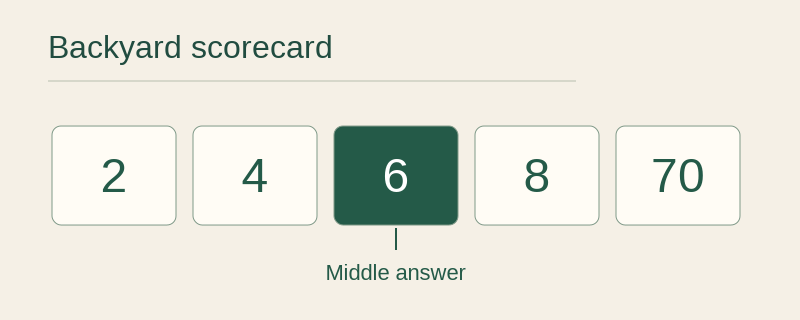
The middle guest answered 6. Adding all five numbers and dividing by five gives 18, which would put your guess three times above the scoring target. Even if the last guest had entered 700, the third answer would still be 6. When you’re stuck, imagine a value with roughly as many guests below it as above it.
What your final score means
A room reveal shows the crowd’s answer and how many people contributed. At the end, your total out of 100 measures accuracy across the five rooms. Your nightly percentile tells you how that total compares with other players facing the same questions. Your headcount counts how many guests finished below you across the nights you played. Ties add nothing. That count can still rise after you leave as more people finish.
FlightQ’s daily Headcount population map
FlightQ gives everyone five population targets a day. Each round starts with a number and a world map showing how densely people live in different places. You choose where to draw. Two loops that cover the same land area can contain very different numbers of people.
How to draw a round
- Read the target and find a region you recognise. Use the bright clusters to locate population centres. Zoom in when you want to follow a particular coastline or leave out a neighbouring city.
- Trace one closed loop. A circle is fine, but you can follow any shape. Slide the loop or redraw it while deciding. The population inside stays hidden until you lock in your drawing.
- Submit to reveal the estimated population and your score. Check whether you overshot or fell short before moving on to the next target. FlightQ uses the European Commission Joint Research Centre’s GHS-POP population grid (2025 epoch).
How FlightQ scores a loop
One round pays up to 100 points, for a daily total out of 500. Divide the enclosed population by the target to get your ratio. FlightQ calculates the score as 100 × (1 − |log₁₀(ratio)|), with a minimum of zero, displayed to one decimal place.
For a made-up target of 8 million, a loop enclosing 4 million scores 69.9. A loop enclosing 16 million also scores 69.9. One is half the target and the other is twice the target. If your first drawing encloses twice as many people as you wanted, look at the bright clusters you could leave outside next time. Cutting the area in half only works if the population is spread evenly.
FlightQ’s official rules and scoring table
Headcount party FAQ
Can I play tonight’s party twice?
Each guest gets one attempt at the current party. You can start any time before the next door opens. The official archive lists completed nights once their results are final.
Can friends compare scores without seeing the answers?
Yes. The share result contains your score and room moons. To compare the same night with friends, start a crew after playing and send them the invite link.
What happens to my streak if I miss a night?
Seven consecutive nights earn a rain check. If you have one when you miss a night, the game spends it automatically to preserve your streak. You can keep up to two.
Party rules checked on headcountgame.com on November 20, 2026, using the official FAQ and scoring guide. Map rules checked on flightq.app the same day. Daily Games List is independent of both games and their developers.
More daily games
If you liked predicting other players, try Noillirk for another survey game. For more estimation, Magnitudle asks you to judge size visually. For a daily trivia challenge with a different scoring system, see Daily Orbs. Browse the daily games list for the full lineup.
For a game that rewards thinking of an unusual answer, see Krillion’s rarity tiers. For another take on a number, try Plain: seven rounds, and the closer your guess, the higher you climb.