VOLCANO Daily Game Guide to Your First Run
The VOLCANO daily game gives you five short challenges and adds their scores together. You might stop a clock in one round and place a map pin in another. If you remember climbing a volcano through seven questions with 25 seconds for each, you’re looking for Kabloom. For the five-game challenge, start here.
Play VOLCANO on the official site
The button opens the developer’s site in a new tab. You can see the lineup before you play. Allow about three minutes for a run. Sign in first if you want today’s result saved to your account.
Read the lineup before starting the clock
On the welcome screen, find the challenge number and read the five game names from top to bottom. You can do this without starting the run. That distinction matters because only your first run counts for the day. If a friend sends you a score to beat, check that you are looking at the same challenge number. Two people playing on the same local calendar date can get different sets if one starts on the other side of the UTC reset.
The five rounds below appeared together on November 22, 2026, as challenge No. 29. The VOLCANO game draws from a larger set. In the official bot history, No. 28 included Hot Seat and Wordsmith, and No. 27 opened with Higher or Lava. Use the names on the welcome screen to pick the advice that fits your edition.
1. Time Fuse — stop on the target
Read the target time before concentrating on the moving clock. The important number is the gap between the target and the moment you stop it. Past results in the bot profile report that gap in milliseconds. If you stop at 3.75 seconds on an illustrative target of 4.00 seconds, you are a quarter of a second early, or 250 milliseconds off. That tells you the direction of the error. The public lineup gives no point deduction for that specific miss.
2. Trivia — read the qualifier
Trivia spans five difficulty tiers from Easy through Impossible. A tier is a difficulty label. It does not promise five questions in every round. For instance, past entries in the official bot history report correct answers out of three. Read the whole question before committing to the first familiar name. A word such as “earliest” can change which of two otherwise plausible choices fits. Use the score awarded at the end of the round when doing the arithmetic below. A count of correct answers alone need not tell you the points.
3. Time Warp — put events in order
Start with the two events whose order you know best. Place the other events relative to those anchors. Getting the oldest event right helps, but it still leaves every pair of later events to sort out. With five events there are ten distinct pairs. Swapping two neighbors reverses just their mutual order, while moving the earliest event all the way to the end reverses four pairs. The bot history reports pairs in past editions, so this is one way to understand why two sequences with the same first event can earn different results.
4. Higher or Lava — compare like with like
Choose which of the two things is bigger on the measure the prompt names. A place can cover more land and still have fewer residents. Before you choose, put the unit into your own question, such as “Which has more people?” That short step keeps the more familiar name from winning the comparison by default. Past bot scorecards show the number of correct comparisons. If this is your best event, read its contribution alongside your other four scores. Even a perfect comparison round supplies only one fifth of the available total.
5. Pinpoint — narrow the map before dropping the pin
The game gives you a blank world map. Pick the broad region first, then use a coastline, a neighboring country or a recognizable bend in a continent to narrow your position. A country name alone may leave a lot of ground to cover. Think of finding a city on a long coast. Choosing the correct end of that coast can matter even after you know which country you need. The official history pairs some Pinpoint results with an average distance in kilometers. Read that figure as a measure of location error. The awarded points are shown separately.
Can the last round still get you to 4,000?
Each mini-game is worth up to 1,000 points, so the VOLCANO daily game has a ceiling of 5,000. To judge a target during a run, subtract your subtotal from the score you want. Then compare the gap with the points available in the rounds you have left.
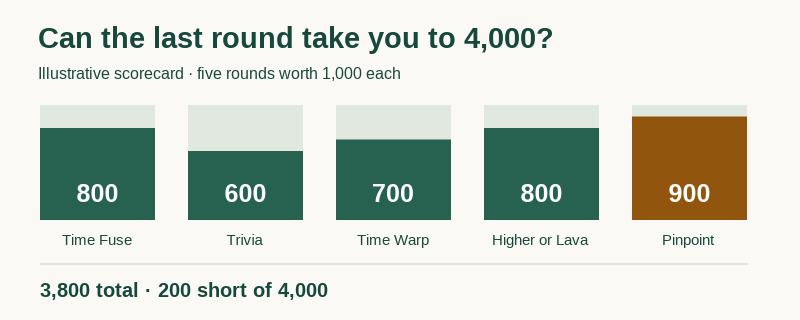
Here is a made-up scorecard, using the No. 29 lineup. Your first four rounds earn 800, 600, 700 and 800. That gives you 2,900 before Pinpoint. To finish on 4,000 you would need 1,100 points from the map. The round can supply at most 1,000, so your highest possible finish is 3,900. A 900-point pin round instead takes you to 3,800. You missed the target by 200 overall, even though you left only 100 points on the table in the last round.
Now try it from the other direction. If your target is 3,500 and you enter the last round on 2,900, you need 600. If your target is 4,000, you want at least 3,000 banked before round five. This calculation works even when tomorrow’s VOLCANO game gives you a different lineup. It only uses the five round caps and the score you have already earned.
What the first-run rule means at midnight UTC
A new VOLCANO daily game opens at 00:00 UTC. Beijing runs eight hours ahead of UTC, so the change happens at 08:00 in Beijing. At 07:55 on Sunday in Beijing, it is still 23:55 on Saturday by the game clock. At 08:05 that same Sunday, it is 00:05 UTC and the Sunday edition is open. If you want to play a particular edition, leave time to finish before the change. The public start screen does not explain what happens to a run that straddles midnight.
For a fair comparison with friends, agree on the challenge number before sharing totals. If you played Saturday evening and a friend played Sunday morning, you might have the same challenge, depending on your time zones. The number removes that ambiguity. If saving the result matters to you, use the welcome screen’s login option before the first attempt. A later attempt cannot improve the day’s counting score.
How to read VolcanoBot’s result
VolcanoBot plays the same puzzles with the same scoring as the player. Open its profile from the welcome screen and find the row with your challenge number. The large number is its total. The five smaller numbers show where it earned those points. For an example from the official record, on No. 29 the bot earned 581 in Time Fuse, 600 in Trivia, 700 in Time Warp, and 1,000 apiece in Higher or Lava and Pinpoint. Those add to 3,881.
Compare that with the illustrative 3,800 above. You earned 219 more than the bot on the clock, matched it on Trivia and Time Warp, then gave up 200 on the comparisons and 100 on the map. The net difference is 81 points in the bot’s favor. That breakdown tells you more than the total alone. VolcanoBot represents a simulated player, so beating its score tells you how you did against that benchmark. It gives no percentile among human players.
Pick another daily game
For a VOLCANO game night with friends who like trivia, try Headcount’s party quiz next. If your favorite moment was choosing the larger quantity, Magnitudle gives estimation a game of its own. You can find both in the daily games list.
VOLCANO daily game questions
Do I need an account to start?
You can enter the daily challenge as a guest. If you want the result attached to your account, use the login option on the welcome screen before you start playing.
Can a second attempt replace my first score?
The day's first run is the one that counts. Treat the start button as the beginning of your scored attempt, even if you are opening the game for the first time.
Does the lineup always start with Time Fuse?
The order and selection can change. For example, Day 29 opened with the clock challenge. Day 28 also opened with it, but the next two games were Hot Seat and Wordsmith.
How many points can I earn in the final round?
The fifth round has the same 1,000-point ceiling as each of the first four. Add 1,000 to your subtotal to see the highest finish you can still reach.
At 07:59 in Beijing, which challenge am I looking at?
At that moment it is 23:59 UTC on the preceding date. The new challenge begins one minute later. Check the displayed challenge number when you return after the changeover.
Is VolcanoBot the high score for the day?
Its entry is a simulated player's result. Open the bot profile for that day's total and the points it earned in each mini-game. The highest possible player score is 5,000.
Can I use a Kabloom strategy here?
Saving a possible answer for a later question makes sense in Kabloom, where an accepted answer can only be used once. In VOLCANO, first identify the task on screen. A clock stop, a historical sequence and a map pin all call for different decisions.
Does the official site give an exact score for every map distance?
The public lineup describes the map task, and the bot history shows distances beside some past results. Neither gives a complete conversion table. Use the points shown for your own round when you add up your finish.
Daily Games List is an independent guide with no affiliation to VOLCANO. Lineup, reset, first-run notice and VolcanoBot history checked on the official VOLCANO website on November 22, 2026.